
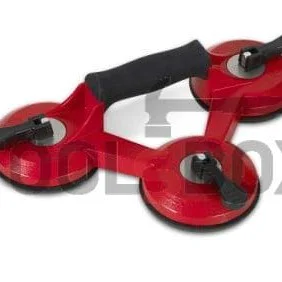
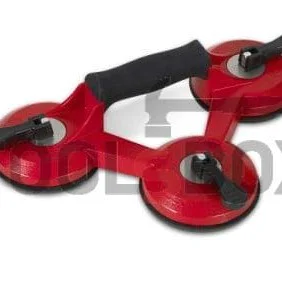
Suction cups for tiles
Tile lifters for precise handling and installation
Tile suction cups facilitate the lifting, moving, positioning, and installation of ceramic tiles, porcelain tiles, earthenware, terracotta, and large-format cladding slabs. They grip smooth or slightly textured surfaces using vacuum suction and provide stable control during work without direct contact with the edges. This reduces the risk of dropping, chipping, and misalignment, and for heavier slabs, it allows for more comfortable work by two installers.
The range includes single-hand vacuum lifters, double and triple holders, vacuum models with a pump, versions with a control indicator or pressure gauge, as well as solutions for larger tiles and countertops. The selection is based on the tile's size and weight, the type of surface, the installation method, and the frequency of use. For professional tilers, the suction cup is part of their daily equipment, and for home renovations, it helps ensure safer handling of larger and more expensive materials.
Applications for gluing, carrying, and leveling tiles
Tile lifters are used for installing floor coverings, wall tiles, steps, kitchen backsplashes, bathroom tiles, terrace tiles, facade elements, and decorative slabs. They are useful when carrying tiles from the packaging to the work area, when placing them on the adhesive layer, when fine-tuning their position relative to the joints, and when lifting a tile that has already been positioned before final pressing.
With large-format porcelain tiles, a secure grip is particularly valuable because the tiles have a larger surface area, greater weight, and a smaller margin for error during installation. The suction cup allows for a more even distribution of force, facilitates work with leveling systems, and protects the front surface from unnecessary stress caused by hands or tools.
Types of tile suction cups
Single-hand suction cups
Single-head models are compact and convenient for smaller tiles, sanitary fixtures, glass panels, and smooth-surfaced elements. They are activated via a lever mechanism or by pressing and are a practical choice for short installation tasks, maintenance work, and home repairs. The smaller diameter allows for maneuverability in tight spaces, around corners, niches, and openings.
Double and triple suction cups
The double and triple versions distribute the grip over a larger area. This is useful for heavier slabs, long items, and materials that bend or twist if gripped incorrectly. More contact points provide more stable handling during transport and placement, and the wider handle allows for more comfortable pulling, turning, and position adjustment.
Vacuum suction cups with a pump
Vacuum suction cups with a manual pump provide more controlled suction. They are ideal for large slabs, smooth porcelain tiles, stone, glass, and other flat materials. Some models feature a vacuum loss indicator, which helps the operator monitor the grip's status during operation. This type is convenient for extended positioning, when the slab is held in the air or carefully aligned with adjacent rows.
Specialized solutions for large formats
For XXL slabs and thin porcelain tiles, suction cups with a larger contact area, ergonomic handles, and the ability to work in combination with support rails or frames are preferred. For such tasks, the focus is on load capacity, the number of grip points, and how the force is distributed across the material.
Criteria for selecting a tile suction cup
- Tile size and weight: Larger and heavier tiles require a larger contact area, more grip points, or a vacuum pump.
- Surface type: The best adhesion is achieved on smooth, clean, and non-porous surfaces. Highly textured, dusty, or wet tiles require extra caution.
- Load capacity: The value specified by the manufacturer serves as a guideline. For safe handling, allow for a margin relative to the weight of the material.
- Clamping mechanism: lever models are fast for short operations, while pump models provide more precise control over the vacuum.
- Handle shape and comfort: A stable grip reduces fatigue during prolonged installation and makes it easier to work with gloves.
- Cup material: The elastic rubber should fit snugly and leave no marks on the surface.
Safety when working with suction cups
Before gripping, clean the tile of dust, sand, adhesive residue, and moisture. Inspect the rubber cup for cracks, hardening, or dirt along the edge, as even a small defect can compromise the vacuum. When moving heavy tiles, do not stand under the load, do not exceed the maximum load capacity, and do not rely on a single suction cup for large tiles.
For precise positioning on adhesive, place the suction cup so that it does not interfere with leveling wedges, crossbars, or guides. When working in bathrooms and wet areas, the surface must be as dry as possible in the gripping area. For outdoor installation, dust, temperatures, and wind are factors, so the movement of the slab should be planned in advance, and teamwork should be clearly coordinated.
Maintenance and Storage
After use, clean the rubber cups with a soft cloth and protect them from sharp edges, shavings, direct sunlight, and harsh chemicals. Store the suction cups without compressing the rubber part to preserve the shape of the sealing edge. Pump models should be checked periodically to ensure the mechanism moves freely and the area around the valve is clean. This ensures a reliable grip for every subsequent task.
Tile Suction Cups at Toolsbox.bg
At Toolsbox.bg, you can select tile suction cups based on the size of the tiles, load capacity, number of cups, and preferred gripping mechanism. Compact manual models are sufficient for small repairs, while professional installation of large-format porcelain tiles requires more robust vacuum solutions and a more careful selection of capacity. Compare the specifications of the individual models and choose a tile suction cup that suits the material, work environment, and installation method.