
Dehumidifiers
Dehumidifiers for dry, healthy, and easier-to-maintain spaces
Dehumidifiers are devices designed to remove excess moisture from the air in homes, offices, warehouses, garages, workshops, and service areas. They reduce condensation on windows and walls, lower the risk of mold, and help with drying after repairs, painting, spackling, leaks, or deep cleaning. The Toolsbox.bg product range offers solutions for home use and for more demanding tasks in spaces where humidity interferes with comfort, material storage, or the normal progress of renovation work.
As part of cleaning equipment, these devices play a practical role not only in maintaining drier air but also in finishing work, facility maintenance, and protecting tools, equipment, furniture, flooring, and building materials. A well-chosen dehumidifier facilitates environmental control in poorly ventilated rooms, north-facing areas, basements, laundry rooms, bathrooms, new construction sites, or sites following wet processes.
What dehumidifiers include and where they are used
Dehumidifiers differ in operating principle, capacity, controls, noise level, tank size, and the ability to drain water via a hose. Compact models are suitable for bedrooms, small offices, closets, and rooms with moderate humidity. More powerful units are in demand for renovations, drying walls and floor screeds, storage areas, garages, and workshops, where moisture accumulates more quickly and a higher moisture removal capacity is required.
There are many practical applications: reducing condensation during the cold months, drying out after a water leak, faster drying of laundry indoors, and protecting wooden surfaces, power tools, hand tools, metal parts, and consumables from corrosion. In storage and service areas, humidity control is directly linked to better preservation of materials, spare parts, and work equipment.
Types of dehumidifiers by technology
When selecting a device, it is helpful to understand the basic technologies. Different designs perform better at different room temperatures, areas, and humidity levels. The table below compares the most popular options based on practical application.
| Device type | Characteristics | Application |
|---|---|---|
| Compressor dehumidifiers | They work by cooling the air and condensing moisture into a tank | Homes, offices, basements, rooms with moderate to high humidity |
| Adsorption models | Rely on moisture-absorbing material and maintain good performance at lower temperatures | Unheated rooms, garages, storage areas, seasonal properties |
| Compact thermoelectric units | Quiet and compact, with more limited capacity | Closets, small rooms, cabinets, local areas with low humidity |
| Professional dehumidifiers | With higher airflow, reinforced housing, and the ability to operate continuously | Construction, renovation, emergency drying, maintenance activities |
Criteria for selecting a dehumidifier
The first parameter is the moisture removal capacity, usually specified in liters per day. Larger spaces, damp basements, and post-renovation sites require higher capacity, while a more compact unit is sufficient for a small room. The area, ceiling height, temperature, ventilation level, and source of moisture should be taken into account.
The tank capacity affects how often it needs to be emptied. For continuous operation without constant monitoring, a model with a larger tank or an option for continuous drainage of water to a drain, siphon, or external container via a hose is practical. For residential use, noise level, night mode, handles, wheels, and easy filter cleaning are also important.
Humidity control makes it easier to maintain the desired levels. Many units feature a hygrostat, display, timer, full-tank indicator, and automatic shut-off when the tank is full. For heavy-duty use in renovation or service environments, a sturdy housing, stable airflow, and easy access to the filters for maintenance are valuable features.
Dehumidifiers for renovation, construction, and workshops
Dehumidifiers are widely used in construction and renovation work because wet processes release significant amounts of moisture. Putty, plaster, mortar, adhesives, and paint dry more predictably in a room with controlled humidity. This helps keep the work schedule on track and reduces the risk of unpleasant odors, stains, and recurring condensation.
In workshops and service centers, moisture can affect metal tools, fasteners, power tools, batteries, measuring equipment, and consumables. Maintaining a drier environment is beneficial for storing lumber, varnishes, paints, abrasives, electrodes, and other moisture-sensitive materials. For such spaces, dehumidifiers with higher capacity, durable casings, and easy maintenance are preferred.
Convenience, Safety, and Maintenance
When using a dehumidifier, it is recommended that the unit be placed on a level surface with sufficient clearance around the air intake and exhaust. Filters should be cleaned according to the manufacturer's instructions, and the reservoir should be emptied regularly to prevent odors and the buildup of contaminants. When using a drain hose for extended periods, a steady slope toward the drain point is required.
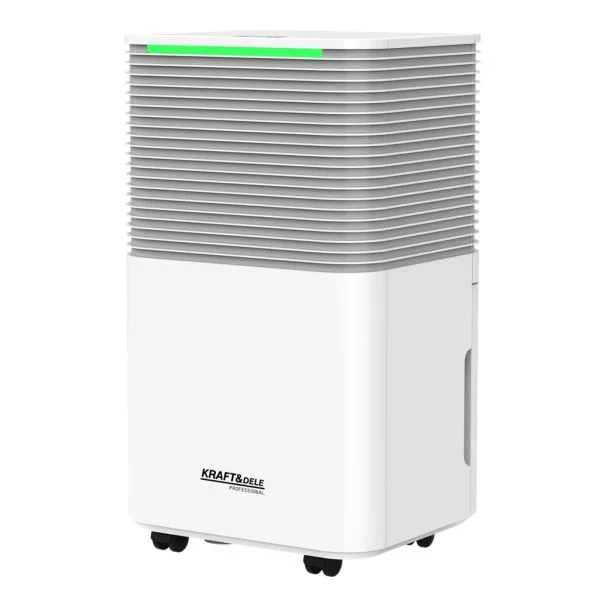
Dehumidifiers with wheels, handles, and compact dimensions are convenient for moving between different rooms. For home use, quiet operation and easy control are valued, while in repair and service environments, performance, durability, and the ability to continuously drain water are key. In rooms with dust following construction work, regular filter maintenance extends the device's lifespan and keeps the airflow stable.
Choosing dehumidifiers from Toolsbox.bg
Dehumidifiers at Toolsbox.bg are a practical solution for humidity control in your home, office, workshop, garage, or renovation site. Compare models by capacity, tank size, technology, controls, noise level, and drainage options to select a unit suited to your space and workload. This ensures a drier environment, better working conditions, and more reliable protection for equipment, materials, and interior surfaces.