
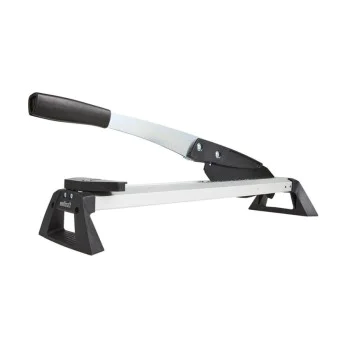
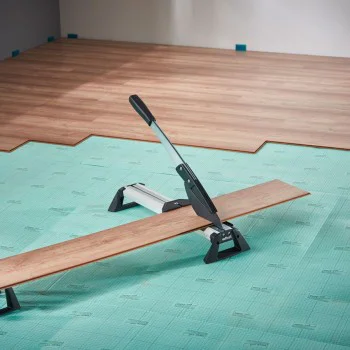
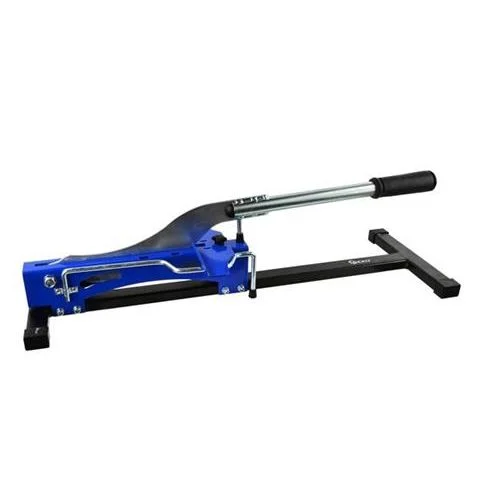
Guillotine for laminate
Laminate Cutter for Clean, Precise, and Convenient Cutting
A laminate cutter is a practical hand tool for cutting laminate flooring panels during installation, repair, and finishing work. It operates without an electrical power source, featuring controlled movement of the cutting mechanism and a stable support for the workpiece. This makes cutting quieter, with less dust, and eliminates the need for extension cords, blades, or complex workplace setup. This type of equipment is a valuable choice for craftsmen, installation teams, and discerning homeowners who want straight cuts when laying flooring.
Among cutting machines, the guillotine stands out for its compact size and ease of use. It is designed for batch cutting of planks, adjustments around walls, doors, columns, and other areas where panels must fit precisely. A laminate guillotine is particularly convenient for use in living spaces, as it does not scatter material like a circular saw and does not generate loud noise.
Applications in flooring installation
A laminate cutter is used when installing laminate flooring in homes, offices, commercial spaces, and workshops. It facilitates cutting end rows, transitions between rooms, and areas around door frames. When the panel is positioned correctly, the tool helps achieve a straight cut, reducing the need for additional finishing.
Different models are designed for different widths and thicknesses of laminate panels. Some variants handle only straight cuts, while others have the ability to cut at an angle, which is convenient for rooms with non-standard layouts. For more intensive professional use, the stability of the base, the length of the lever, the shape of the blade, and the secure clamping of the workpiece are important.
When is a laminate cutter more convenient than a power tool
For interior renovations, a laminate cutter often saves time on preparation and cleanup. No protective covers against fine dust are needed, no blades need to be changed, and there are no sparks or cables on the floor. This makes it suitable for finishing work after painting, when renovating already furnished rooms, and when installing flooring in buildings where noise must be kept to a minimum.
Power tools have their place for complex cuts, curved shapes, and details with specific profiles. However, the guillotine is very convenient for repetitive straight cuts and quick adjustments along the length of the panel. The combination of hand tools, measuring instruments, and a sturdy guillotine creates a streamlined workflow for flooring installation.
How the different models differ
When choosing a laminate floor cutter, consider the working capacity, the type of cutting mechanism, and portability. Lighter models are practical for home use and occasional repairs, while heavier-duty versions are designed for regular use on job sites. Key factors include cutting length, maximum panel thickness, the presence of a stop, and a clear adjustment scale.
| Criterion | Practical significance |
|---|---|
| Maximum cutting width | Determines which panels can be processed without additional rotation or readjustment. |
| Maximum panel thickness | Depends on the specific laminate flooring and underlayment system. |
| Angle cutting | Useful for diagonal laying and in rooms with irregular walls. |
| Base and support | The more stable construction reduces deflection and makes it easier to cut harder panels. |
| Weight and size | More compact models are convenient for transport between job sites and storage in the workshop. |
Materials, compatibility, and cutting accuracy
A laminate cutter is primarily designed for laminate flooring panels. Before purchasing, it is wise to compare the technical specifications of the selected model with the thickness, width, and structure of the flooring you will be working with. Some panels have a harder surface or a denser core, which requires a more durable blade and a stable lever mechanism.
Accuracy depends on a level surface, proper marking, and securing the piece before cutting. For best results, use a high-quality measuring tape, a square, a marking pencil, and a stable working position. For visible edge joints and transitions to trim, a precise cut reduces material waste and improves the final appearance of the flooring.
Blade, Lever, and Ergonomics
The cutting blade is one of the components that directly affects the cleanliness of the cut. For thicker panels, a longer lever is useful because it reduces the operator's effort. Good ergonomics are evident in the comfortable handle, stable arm, and clear feedback when applying pressure. A laminate guillotine with a well-balanced design facilitates even cutting and reduces fatigue during prolonged use.
Safety and Maintenance
Working with a laminate cutter requires stable placement on a level surface and careful positioning of the panel. Hands should remain outside the blade's path, and scrap pieces should be removed after the cut is complete. Protective gloves are useful when handling panels and working with cut edges, which sometimes have sharp edges.
Maintenance typically involves cleaning the work area, removing dust and small particles, checking the fasteners, and storing the tool in a dry place. If the blade needs to be replaced or adjusted, follow the manufacturer's instructions. This ensures the tool maintains its accuracy and remains ready for the next repair or installation.
Selection Based on Frequency of Use
For occasional home repairs, a compact laminate cutter with a capacity for standard panels is often sufficient. For professional use, look for a more stable construction, a wider working range, and convenient settings for repeatable cuts. When working on different sites, weight and portability are just as important as the maximum cutting size.
Compare models based on actual tasks: room size, flooring type, number of cuts, need for angle cutting, and workspace. A well-chosen laminate cutter speeds up installation, reduces mess, and helps achieve more precise details. Browse the options at Toolsbox.bg and choose a tool that suits your work style, materials, and expected workload.