
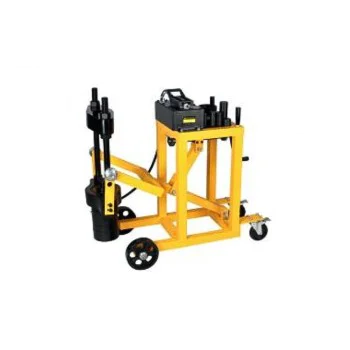
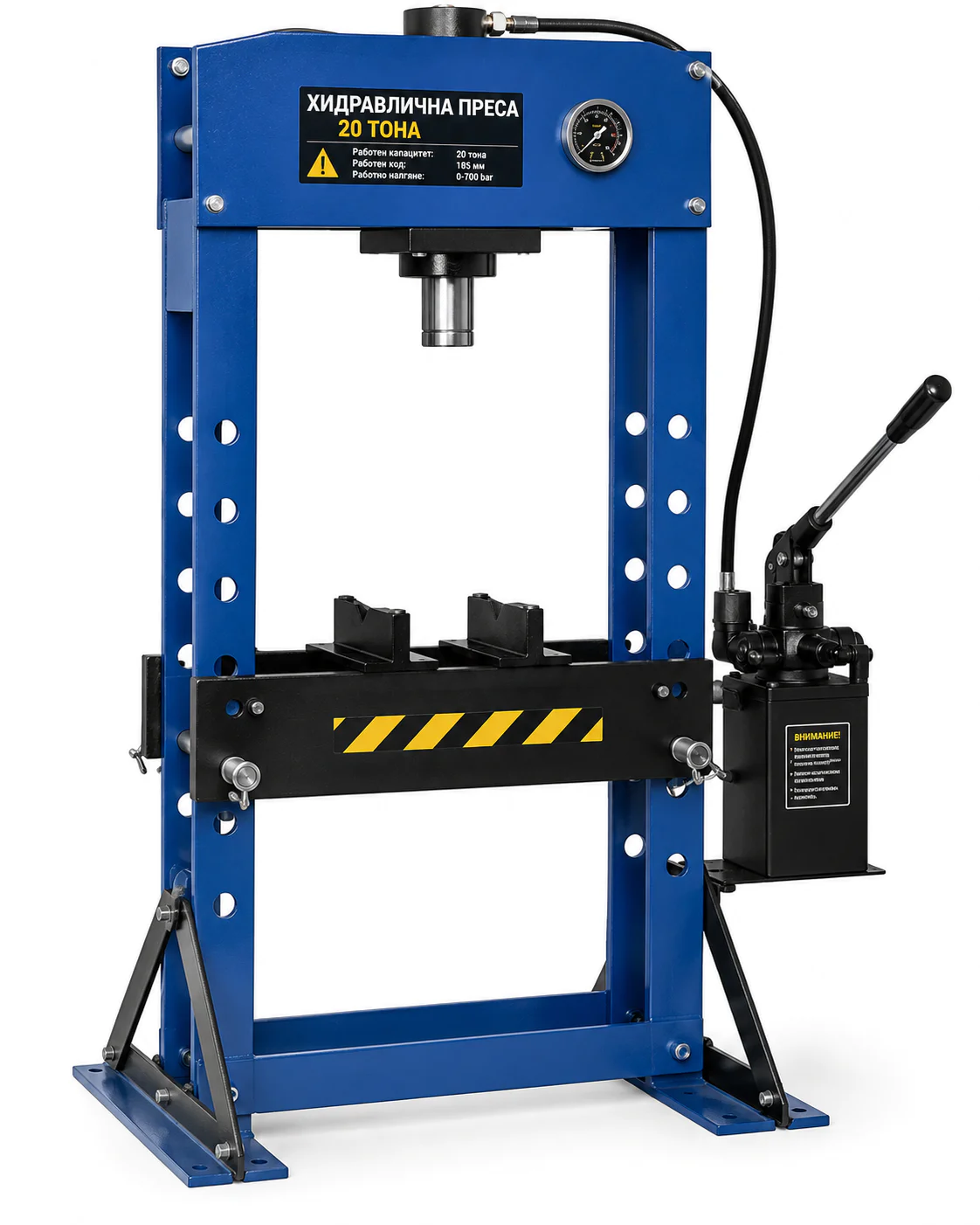
Hydraulic press
Hydraulic Press for Auto Service, Repair, and Workshops
A hydraulic press is a practical machine for controlled pressing, pulling, bending, straightening, and assembling parts using hydraulic force. It is used in auto repair shops, mechanical workshops, garages, production areas, and repair facilities where work is performed on bearings, bushings, joints, axles, gears, metal profiles, and other tightly assembled components. When properly selected, a hydraulic press reduces heavy manual labor and provides better control over pressure, without hammering and without placing unnecessary strain on the part.
At Toolsbox.bg, you'll find models for a variety of tasks-from compact options for garage maintenance to more powerful machines for professional use in auto repair shops. The differences between the individual models are primarily related to pressing force, frame construction, working height, piston stroke, pump control, and the presence of a pressure gauge for monitoring pressure.
Applications of a hydraulic press in an auto repair shop
A hydraulic press is used for replacing and installing bearings, knocking out bushings, pressing in seals, straightening metal parts, and working on the suspension. In service practice, it is valuable for operations requiring a smooth force applied precisely along the axis of the part. This reduces the likelihood of deformation of surrounding parts and ensures a cleaner installation.
In addition to auto repair shops, the machine is used for repairing agricultural equipment, fabricating metal components, tool maintenance, and assembly work in workshops. When used with appropriate pads, prisms, and mandrels, the press adapts to various shapes and sizes of parts, making it useful for a wide range of applications without unnecessarily complicating the process.
Types of hydraulic presses based on design
Bench-top hydraulic press
Bench-top models are compact and are placed on a workbench or stable surface. They are a good choice for service areas with limited space, hobby workshops, and smaller parts. Their advantage is easy positioning, and for light to medium-duty operations, they provide sufficient force for bearings, bushings, and small mechanical assemblies.
Floor-standing hydraulic press
Floor-standing models have their own frame and typically offer a larger work area. They are preferred for heavier parts, more frequent use, and operations requiring higher pressing capacity. The adjustable work table facilitates height adjustment, and the solid construction contributes to stability under load.
Hydraulic press with pressure gauge
The pressure gauge provides control over the applied force and is useful for operations where excessive pressure must be avoided. It facilitates repeatability in similar tasks and supports more precise work with sensitive components. This is a significant advantage during maintenance work involving bearings, bushings, and press-fit assemblies.
Hydraulic press with manual or pneumatic-hydraulic pump
The manual pump is common in compact and medium-sized machines. It is easy to operate and provides good control for single operations. Pneumatic-hydraulic variants reduce physical effort during more intensive work and are practical for service shops where the press is used regularly throughout the workday.
Selecting a Model Based on the Application
When choosing a hydraulic press, it is wise to consider the actual tasks, the size of the parts, and the frequency of use. Too small a capacity will limit the application, while a machine that is too large for small tasks will take up space and complicate the work. For auto repair shop use, a good power reserve, a stable frame, and convenient workbench adjustment are typically sought.
- Pressing capacity-measured in tons and selected based on the load during actual operations.
- Stroke length-determines how far the ram can move when pressure is applied to the workpiece.
- Column width-important for larger assemblies, hubs, carriers, and metal workpieces.
- Adjustable table-facilitates centering and working with parts of varying heights.
- Pressure gauge-useful for precision operations and controlling the applied force.
- Pump type - manual for occasional use, pneumatic-hydraulic for more frequent service use.
Compatibility, accessories, and safe operation
Every hydraulic press performs better with properly selected auxiliary components. Prisms, pads, mandrels, and adapters help ensure even pressure distribution and part centering. When working with bearings and bushings, the size of the support elements is of great importance, as improper support damages the workpiece or the machine frame.
Safe operation requires stable positioning of the machine, a clean work area, and proper centering of the workpiece before applying pressure. Do not operate with cracked supports, deformed mandrels, or components that are not securely positioned. Pressure should be applied gradually, and the operator should monitor the workpiece's behavior and the pressure gauge readings, if the machine is equipped with one.
Maintenance and Long Service Life
Regular maintenance of the press includes inspecting the hydraulic cylinder, hoses, pump, connections, and moving parts. Working surfaces must be kept free of contamination, and the frame must be checked for mechanical damage after heavy-duty operations. With hydraulic systems, it is important to monitor the oil level and condition, because clean hydraulic fluid ensures smooth movement and good piston response.
Select a hydraulic press on Toolsbox.bg based on the capacity, working area size, and control method required by your service center or workshop. This will provide you with a machine for precise pressing, repair, and assembly of metal and automotive components for daily or periodic use.