
Pallet trolleys
Pallet trucks for moving palletized loads
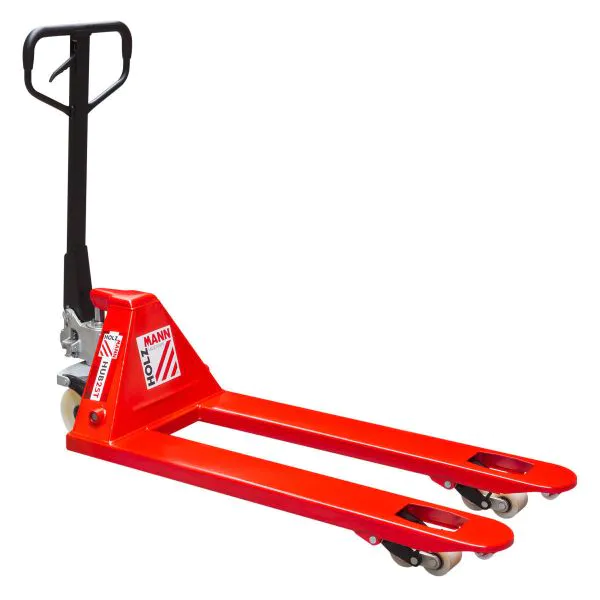
Pallet trucks are practical equipment for transporting palletized loads in warehouses, service centers, workshops, stores, production facilities, and construction sites. They reduce manual effort during loading and unloading operations and help organize materials, tools, supplies, and packaged goods more quickly over short distances. On level ground, a well-chosen hand truck eliminates the need for heavy lifting and simplifies daily logistics without requiring a forklift.
Pallet trucks are in demand both for professional use and for more intensive home use in a garage, farmyard, or small workshop. In construction, they are useful for moving pallets of tiles, adhesives, bags of dry mixes, bricks, blocks, metal profiles, and other materials when the site has a sufficiently firm and level surface. In a warehouse setting, they are used for organizing inventory, loading ramps, servicing trucks, and preparing orders.
Types of pallet trucks according to the task
Varieties include manual hydraulic models, trucks with different fork lengths, low-profile versions, models with built-in scales, scissor-lift variants for raising to a comfortable working height, and electric solutions for more intensive use. The differences between them relate to load capacity, lift height, fork size, wheel type, maneuverability, and control method.
| Type | Practical Application | Distinctive features |
|---|---|---|
| Manual hydraulic | Warehouse, store, service center, construction site | Operated by a hydraulic pump, easy to use, standard pallet handling tasks |
| Low-profile | Pallets with a lower fork entry | Lower starting height and more precise positioning |
| With extended or short forks | Various pallet and load sizes | Better match to the length and width of the load |
| With a scale | Weight control during receiving and shipping | Combines moving and measuring the load |
| Electric | Busier warehouses and long routes | Reduce the effort required for moving and lifting |
How to select pallet trucks for a specific job
Pallet trucks are selected based on the actual load, the type of pallets, and the operating conditions. Load capacity is one of the first parameters to consider, because having a margin above the typical weight protects the hydraulics, forks, and wheels from premature wear. The size of the forks depends on the pallets being moved daily-standard Euro pallets, non-standard bases, longer loads, or compact pallet units.
The wheels have a direct impact on handling. Polyurethane wheels run more quietly and protect flooring in warehouses and stores, while nylon wheels are durable on hard floors and under higher loads. Rubber components improve traction, but their selection depends on the flooring and frequency of use. In the presence of dust, small debris, joints, or unevenness, more careful selection of casters and regular cleaning of the travel path are required.
Load, Pallets, and Work Environment
With construction materials, the load is rarely evenly distributed. Therefore, the forks are inserted all the way under the pallet, and the center of gravity is kept as close to the center as possible. For long boxes, metal profiles, or sheets, look for a design with forks that support the load stably along its length. In areas with narrow aisles, shorter models and a smaller turning radius make it easier to maneuver around racks, machines, and workbenches.
Pallet trucks work best on hard, level surfaces. Ramps, thresholds, slopes, and wet areas require slower speeds and careful control of the load. When working on outdoor sites, rough concrete, or temporary flooring, it is important to consider not only the load capacity but also the condition of the wheels, the lift height, and the stability of the pallet. This reduces the risk of getting stuck, the load shifting, or damage to the packaging.
Hydraulics, Control, and Safe Operation
The hydraulic system is the heart of the hand pallet truck. Smooth lifting, controlled lowering, and a comfortable handle make work easier during repeated loading throughout the day. When selecting a model, consider the pump stroke, ease of turning, visibility of the forks, and ease of control when the truck is loaded. For electric models, additional factors include power supply, speed control, battery capacity, and ease of charging.
Safety depends on proper load distribution, a clean floor surface, and regular inspections. Do not transport people, do not exceed the load capacity, and do not pull the cart over obstacles that could damage the casters or pallet. When lowering the load, do so smoothly, and when moving on an incline, the operator must maintain control over direction and speed. For facilities with more staff, clear traffic rules reduce collisions with racks, machinery, and doors.
Maintenance, Spare Parts, and Long Service Life
Pallet trucks require periodic inspection of wheels, rollers, axles, forks, the hydraulic cylinder, and the handle. Debris around the rollers must be removed promptly, as sand, wire, stretch film, and small construction debris hinder rotation and strain the bearings. Signs of hydraulic fluid leaks, uneven lifting, or difficulty lowering indicate the need for a service inspection. Timely replacement of worn parts protects the load and extends the equipment's service life.
At Toolsbox.bg, you'll find pallet trucks for warehouse work, maintenance, installation, repair, and construction tasks. Compare load capacity, fork length, wheel type, lifting method, and ease of operation to select a model that suits the load and environment at your site.