
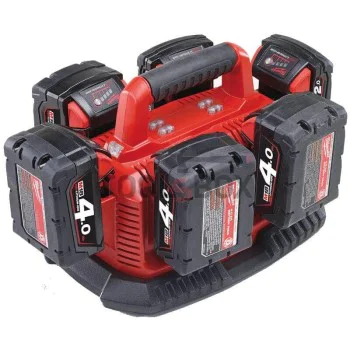
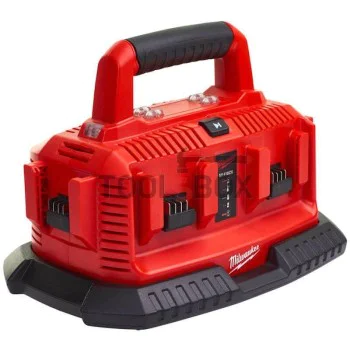
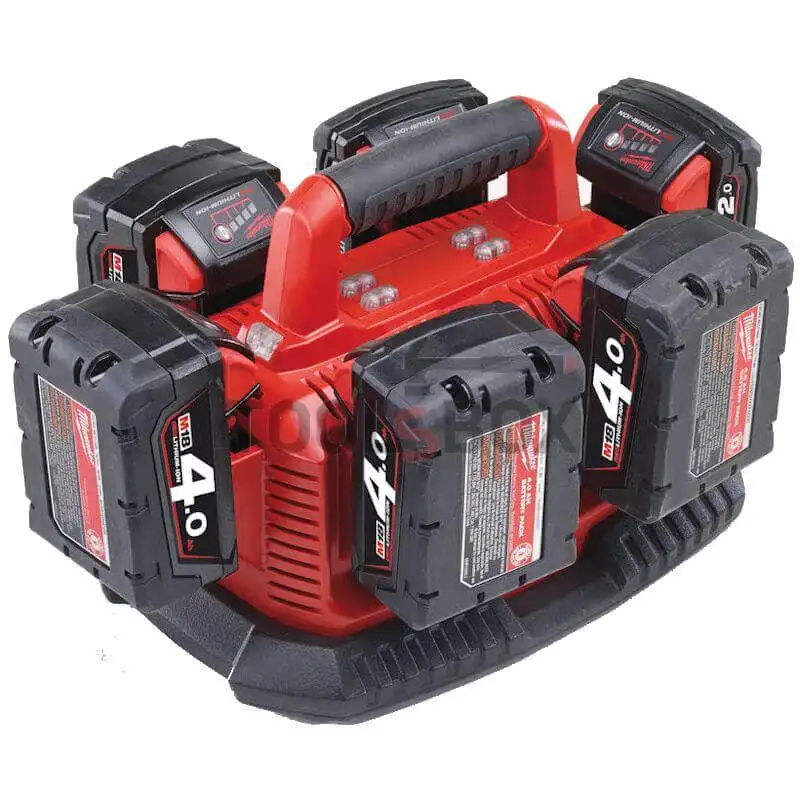
Charging station
Charging Station for Rechargeable Batteries and Power Tools
A charging station is a practical device for organized charging of rechargeable batteries, battery packs, and compatible devices in a workshop, service center, garage, construction site, or home repair area. It centralizes charging in one place, reduces the clutter of individual adapters and cables, and keeps power tools, measuring equipment, lighting, garden tools, or other battery-powered equipment ready for use.
When working intensively with screwdrivers, angle grinders, saws, hammer drills, vacuum cleaners, lamps, and other battery-powered tools, a well-chosen station saves time and makes task planning easier. Instead of individual chargers scattered across tables and shelves, a compact base provides an organized space for batteries and easier monitoring of their status.
What charging stations cover
The range of charging stations includes models for one or more batteries, docking stations for specific battery systems, wall-mounted and desktop versions, combination stations with multiple outputs, and charging stations with charge status indicators. Some models are designed for compact batteries used in handheld power tools, while others work with larger battery packs for garden machinery, lighting fixtures, or mobile equipment.
The differences between the individual models are evident in the number of charging ports, supported voltage, charging current, battery type, housing design, and mounting method. For professional use, a higher workload capacity and clear process indication are required, while for a home workshop, a compact station that is easy to use and sits stably on a workbench is often sufficient.
Applications in workshops, service centers, and on-site
The charging station finds its place wherever cordless tools are used and the equipment needs to be ready for the next task. In service centers and installation teams, it helps organize batteries by capacity, charge level, and purpose. In construction and renovation, the charging station reduces the risk of mixed-up or forgotten batteries, and in a home setting, it keeps the workspace cleaner and more organized.
When working with more than one machine, the multi-position station allows several batteries to be charged sequentially or simultaneously, depending on the design of the specific model. This is useful during prolonged drilling, cutting, screwing, sanding, mowing, or cleaning, where interruptions due to a dead battery slow down the pace of work.
How to Choose a Charging Station
Your purchase should start with compatibility with the batteries you already use. Check the battery series, voltage, cell type, and connector type. Even visually similar batteries sometimes work with different chargers, so the technical specifications of the tool and the battery must match.
- Battery compatibility: pay attention to the system brand, voltage, capacity in Ah, and battery technology type, such as Li-Ion or Ni-MH, if specified.
- Number of charging slots: one slot is sufficient for a single tool, while two or more slots are more convenient for teamwork or a set of several machines.
- Charging current: a higher current reduces charging time, but must be within the battery's specified limits.
- Indicators: Light or digital indicators make it easier to monitor the charge level, errors, and readiness for use.
- Installation and location: desktop models are easy to move, while wall-mounted bases save space and keep the charging area tidy.
Comparison of main types of charging stations
| Type | Characteristic | Practical use |
|---|---|---|
| Single-slot station | Compact base for a single battery | Home repair, single power tool, backup charging base |
| Multi-position station | Multiple battery slots for a single system | Service, installation work, working with multiple machines |
| Combined station | Charging different devices or batteries depending on the model | Workshops with diverse equipment and a need for an organized charging area |
| Wall-mounted charging station | Mounting to a wall or workbench | Permanent workspace, garage, service area |
Compatibility, safety, and maintenance
Compatibility is crucial for the charging station to function properly. Use only batteries that meet the specifications provided by the charging station manufacturer. Incorrect voltage, a different cell type, or an incompatible connector system can damage the battery, the station, or connected equipment.
For safer operation, place the station on a stable surface, away from moisture, metal shavings, dust, and sources of high temperature. When working in a service center or on a construction site, ensure the cable is protected from being pinched or tripped over, and that the ventilation openings remain unobstructed. Periodically clean the contacts with a dry cloth and inspect the housing, cable, and plug for visible damage.
Models with temperature control, overload protection, and error indication make daily battery management easier. For more intensive use, it is wise to choose a station with clearly visible light signals, a stable base, and a housing that can withstand normal workshop conditions.
A practical choice for an organized charging area
A good charging station keeps batteries organized, reduces the time spent searching for an available charger, and makes working with battery-powered tools more predictable. Browse the options at Toolsbox.bg and choose a model compatible with your batteries, tools, and workflow.