Hunebeck
Hünebeck props for formwork, shoring, and construction operations
Hünnebeck is a practical solution for temporary shoring in formwork, installation, and repair tasks that require stable support for slabs, beams, formwork panels, or other temporary structures. This term typically refers to adjustable metal supports with a telescopic mechanism, used in construction to transfer vertical loads during work with concrete, formwork, and shoring systems. They are used both on construction sites and for smaller repair projects where a controlled height, sturdy steel support, and easy adjustment of the working position are required.
This section includes Hünnebeck-type variants with different working heights, structural designs, tube diameters, locking systems, and load-bearing capacities. The differences between the individual models are important when working with horizontal formwork, temporary shoring, opening reinforcement, maintenance activities, or finishing operations, where precise length and stable fixation directly affect safety.
What is a Hünebeck-type prop?
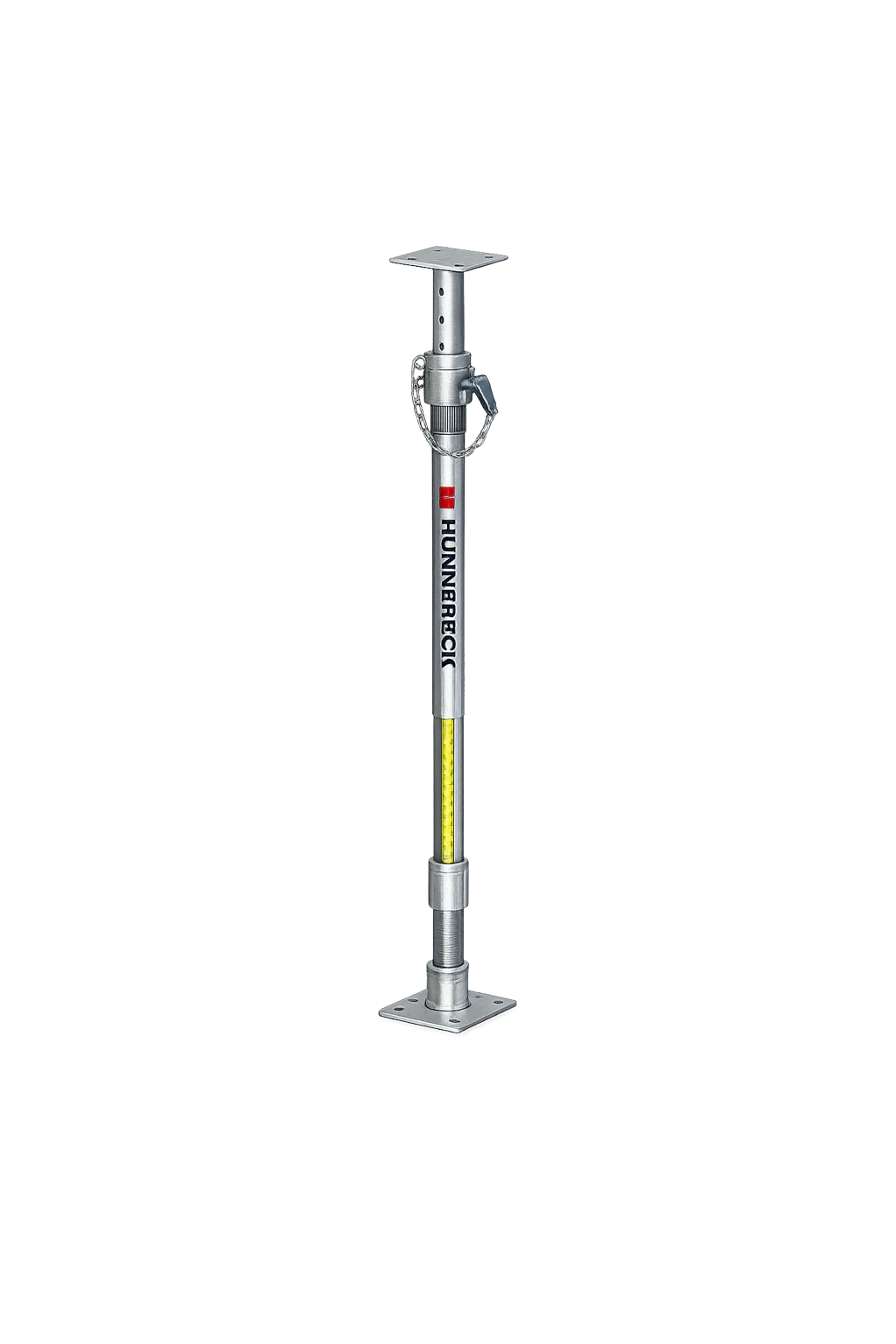
The Hünnebeck prop typically consists of two steel tubes that slide into one another, a screw mechanism for fine adjustment, a locking pin, and support plates at both ends. This design facilitates quick height adjustment and allows for precise alignment of the formwork before pouring concrete or securing a temporary element. Working with such a prop requires proper positioning on a stable foundation and even load distribution.
When forming Hünebeck slabs, the props are used to support formwork beams, panels, plywood, or compatible formwork systems. During repair work, they can support temporary beams, reinforce areas around openings, or assist in the installation of structural elements. In warehouse and maintenance work, they are useful when a temporary vertical support is needed with the ability for quick adjustment.
Main applications in construction and renovation
Hünebeck is most commonly used in formwork operations, but its application is not limited to concrete work. The metal telescopic props are used for temporary bracing, installing heavy components, supporting beams, leveling formwork systems, and securing work areas during repairs. When the height is correctly selected and the load-bearing capacity is sufficient, they facilitate work organization and reduce the need for improvised supports.
- Formwork for concrete slabs-supporting horizontal formwork elements until the concrete reaches the required strength.
- Installation and repair-temporary fixation of beams, frames, openings, and structural sections.
- Reinforcement-maintaining stability during demolition or finishing work.
- Workshop or service operations-temporary support during the fabrication, adjustment, or positioning of heavier components.
Differences between Hünebeck models
When selecting Hyunebek props, the working range is the first consideration. Shorter models are suitable for low-ceilinged spaces, confined areas, and localized repairs, while longer models are preferred for formwork on higher slabs or in industrial facilities. The adjustment range should cover the required height without operating at the fully extended position, as stability is better when the prop remains in the middle of its stroke.
Another factor is load-bearing capacity. This depends on the design, material thickness, pipe diameter, span height, and the overall condition of the prop. For formwork operations, the load is distributed across beams, heads, tripods, or other auxiliary elements, so compatibility between the parts is important. For heavier formwork systems, a more robust design is selected, and the layout specified for the specific project is followed.
Material, Coating, and Wear
Most Hünebeck-type props are made of steel, as the material withstands significant vertical loads and impacts during construction work. The coating protects the metal from corrosion, dirt, and concrete residue, but does not eliminate the need for cleaning after use. Bent tubes, damaged threads, missing pins, or deformed feet impair proper functioning and should not be ignored.
Adjustment and Fixing
The screw mechanism is an important part of every Hünebeck prop because it allows for fine height adjustment. Coarse adjustment is performed using holes and a pin, and then the nut ensures precise tightening. When selecting a prop, check the ease of rotation, the condition of the thread, the presence of a locking element, and the stability of the support plates. A well-functioning mechanism saves time during installation and removal.
Compatibility with formwork systems and auxiliary elements
Hünebeck props are often combined with formwork beams, formwork plywood, tripods, forks, heads, and other elements for horizontal formwork. When working with an existing system, check the diameter of the top, the shape of the base, the attachment method, and the required adapters. Incorrectly matched components can cause instability, so the dimensions and contact points must match the equipment being used.
For larger projects, it is practical for the props to be of the same type and working range within a given section. This makes leveling easier, and the installation team works with a uniform system. When mixing different models, monitor the height, load-bearing capacity, and condition of each individual prop.
Criteria for Proper Selection
When purchasing Hünebeck props, consider the task for which they will be used, the room height, the expected load, the number of support points, and compatible formwork components. For home renovations, a lighter and more portable model is often sufficient, while professional construction work requires a more durable steel structure, clearly marked parameters, and a stable adjustment mechanism.
- Working height-minimum and maximum length when extended.
- Load capacity-determined by the formwork, concrete, and support distribution.
- Weight and portability-lighter props are easier to move, while heavier ones are designed for more demanding tasks.
- Thread condition-smooth adjustment is important for precise installation.
- Compatibility-check for compatibility with forks, tripods, beams, and other formwork components.
Safety, Operation, and Maintenance
Working with a Hünebeck prop begins with a level and load-bearing base. The base must rest stably, without tilting, slipping, or contact with loose material. The load is transmitted vertically, so the prop is not used as an inclined brace or lever. For formwork operations, the distance between individual props is determined by the structural design, the slab thickness, and the load-bearing elements.
After work is completed, metal parts are cleaned of concrete, mud, and dust. The thread is inspected for contamination and mechanical damage, and the pin is safeguarded against loss. Storage in a dry place extends the life of the coating and reduces corrosion. A quick check before installation is brief but prevents problems on-site.
Hünebeck props at Toolsbox.bg
Hünebeck is a popular choice for contractors, construction companies, formwork specialists, and discerning DIYers who need stable temporary shoring. Browse the available options on Toolsbox.bg, compare working heights, designs, and compatible components, then select the prop that best suits your specific construction, renovation, or installation project.