
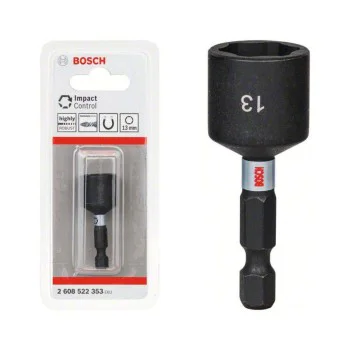
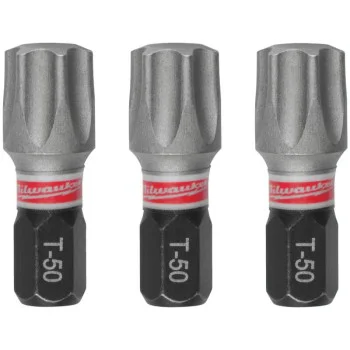
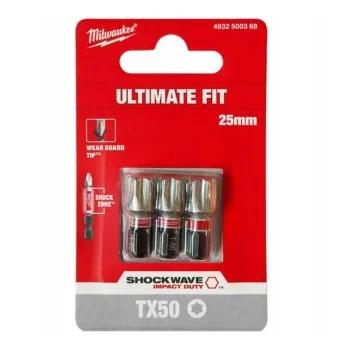
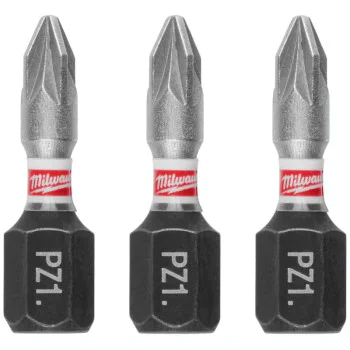
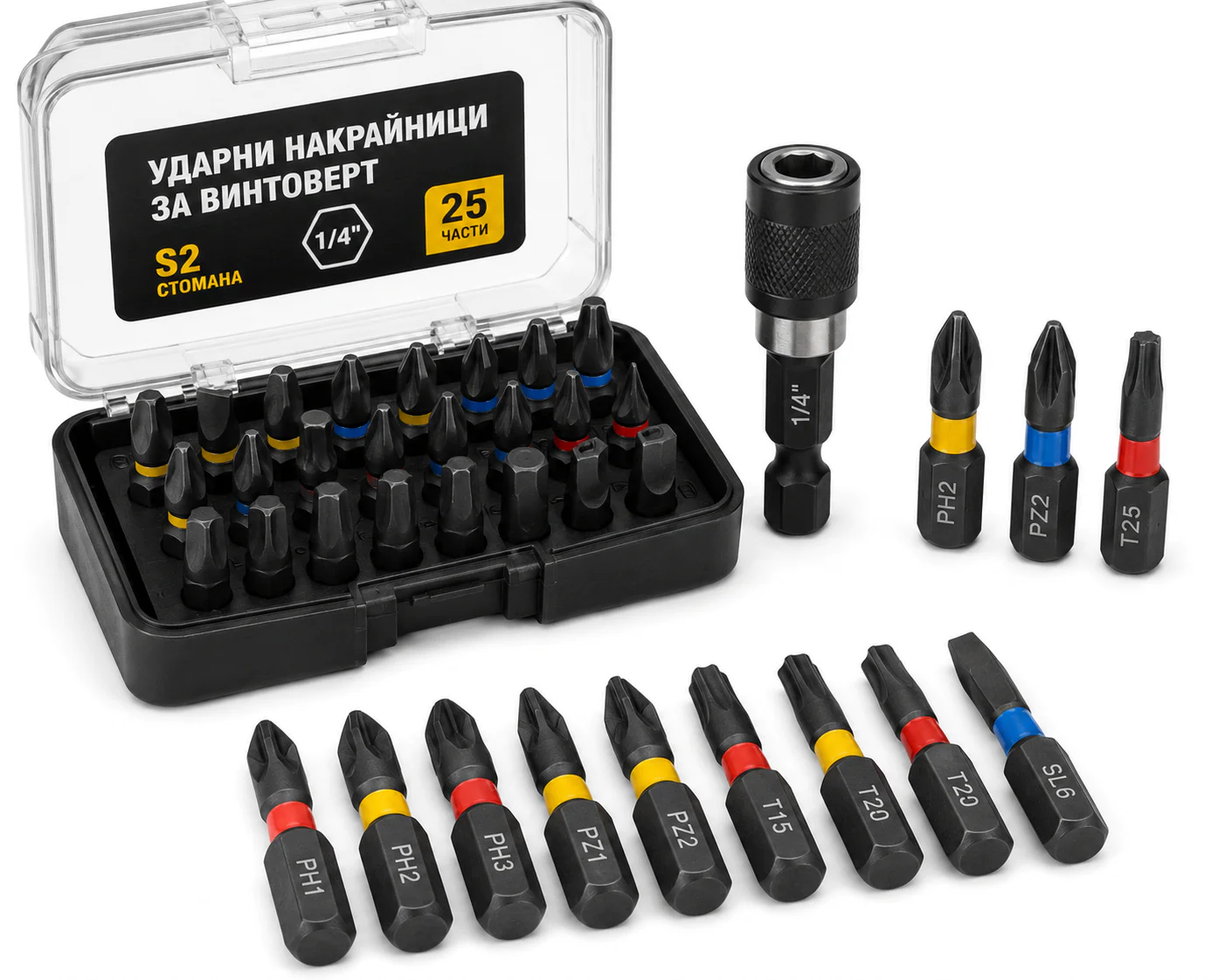
Impact bits for screwdriver
Impact screwdriver bits for secure tightening under load
Impact screwdriver bits are designed for use with impact screwdrivers, impact wrenches with bit holders, and high-torque screwdrivers. They absorb the sudden impacts during tightening and loosening, protect the screw head from damage, and limit the twisting of the bit itself. These types of accessories are valuable for assembling wooden structures, drywall, metal profiles, furniture, fasteners in workshops, service work, and home repair tasks.
The difference from standard bits lies in their more robust geometry and more flexible body. Some models feature a torsion zone that absorbs part of the impact and reduces the load on the tip. This allows impact screwdriver bits to operate more stably during continuous driving, with long screws, in hard materials, and in situations where the power tool delivers strong, short pulses.
Where are impact screwdriver bits used?
Impact bits are selected based on the fastener, material, and machine. When installing OSB panels, beams, wooden substructures, and roofing elements, tips with good torsional resistance are required. When working with metal profiles and self-tapping screws, a precise tip shape is required, as an improper fit leads to slippage and damage to the head. In a service environment, impact screwdriver bits are practical for removing tight screws, installing brackets, strips, hinges, trim, and various assemblies.
For professional use, sets with multiple profiles and lengths are valued because they cover a variety of tasks on-site. For home use, a well-selected set of PH, PZ, and Torx bits is often sufficient for furniture, doors, shelves, electrical panels, minor repairs, and maintenance. Impact screwdriver bits are also a good choice for professionals who work with cordless impact drivers and need more durable accessories.
Main profiles and applications
| Profile | Fastener type | Practical use |
|---|---|---|
| PH | Phillips cross-head screws | General installation and repair work |
| PZ | Pozidriv cross-head screws | Furniture, wood components, construction fasteners |
| Torx | Star-shaped screws | Batch fastening, higher torque, wood and metal |
| Hex | Hexagon socket screws | Fitting, machinery, assembly, and service operations |
How to select impact sockets for a screwdriver
The right choice starts with the screw profile. The tip must fit snugly into the head, without play and without forcing it in. An incorrect size wears out both the bit and the fastener. With PH and PZ profiles, the difference seems small but is significant under load: PZ screws have additional ribs and require a corresponding PZ bit. For Torx profiles, the size is designated with a T, while for hexagonal variants, it is specified in millimeters.
The length of the bit also matters. Short models are convenient when working with a magnetic holder, in confined spaces, and for standard installations. Longer bits provide access to deeper holes, recesses, and hard-to-reach places without an additional extension. When working continuously with the same type of fasteners, it is practical to have spare bits of the most frequently used size.
- Profile and size: PH, PZ, Torx, or Hex depending on the screw head.
- Length: short bits for compact work, long bits for deep holes and limited access.
- Material and finish: alloy steel, hardened, with wear-resistant coatings on some models.
- Shank: standard 1/4" hex shank for most bit holders and sockets.
- Operating mode: impact driver, cordless impact driver, or bit holder.
Compatibility, Material, and Durability
For impact screwdriver bits, compatibility with the tool is crucial for stable operation. The most common are bits with a 1/4" hex shank, which are inserted directly into a bit holder or a suitable adapter. Magnetic holders facilitate screw positioning, while quick-change holders reduce the time required to switch between profiles during installation.
The material determines the bit's resistance to impact loads. Bits made of S2 steel or other alloy steels, with heat treatment and a precision-ground tip, are common. Some impact screwdriver bits feature color coding or markings for quick size identification. In models with a torsion section, the torque is distributed across the body, which protects the tip when working with harder fasteners.
Tips for a longer service life
Impact screwdriver bits work best when the tip and screw are clean, and the tool is set up for the task. Applying excessive pressure does not compensate for an incorrect bit size. During continuous screwing, it is important to check for tip rounding, cracks, twisting, or changes in shape. A worn bit leads to slipping, slower work, and damaged fasteners.
Storing them in a box, organizer, or holder protects the bits from getting lost and from mechanical impact. After working in a dusty or damp environment, it is wise to clean them of shavings, plaster dust, and debris. This keeps the accessories organized and ready for the next installation, repair, or service task.
Select bits according to the machine and the fastener
Well-chosen impact bits make working with power tools easier, reduce downtime, and ensure more precise fastening. When selecting, pay attention to the profile, size, length, shank type, and expected load. For construction crews, installers, furniture makers, technicians, and demanding DIYers Impact screwdriver bits are a practical consumable that must match the actual tasks at hand.
Select impact screwdriver bits from Toolsbox.bg based on the machine, fasteners, and work environment to equip your workshop or toolbox with the right bits for daily installation and repair tasks.