
Triangles
Set squares for precise measuring, marking, and checking angles
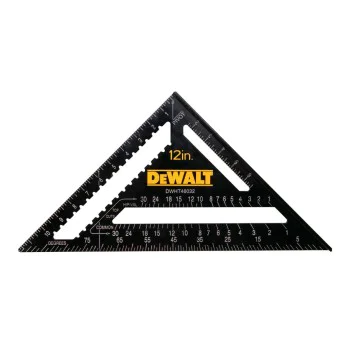
Set squares for measuring and marking are essential for woodworking, installation, construction finishing work, marking details, and checking right angles. They provide a quick reference for cutting, transferring measurements, setting cutting lines, and checking joints. Toolsbox.bg offers a variety of measuring triangles for workshops, construction sites, repair shops, and home improvement projects, with an emphasis on accuracy, ease of use, and clearly marked scales.
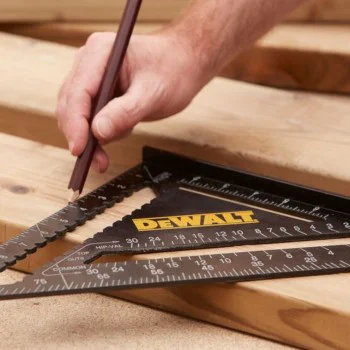
These types of measuring tools are used when working with wood, drywall, metal profiles, panels, laminate flooring, ceramic elements, furniture, and structural components. They are most commonly used for marking 90° and 45° angles, transferring lines, checking perpendicularity, marking repeatable dimensions, and assisting with cutting using hand or power tools. A properly selected set square reduces installation inaccuracies and saves time during repetitive operations.
Applications in repair, installation, and workshop work
In construction and repair tasks, set squares are used for marking out surfaces, checking angles in cladding, and installing shelves, doors, casings, frames, and profiles. In carpentry, they are invaluable for cutting boards, countertops, beams, and furniture components. When working with metal profiles, they facilitate precise marking before cutting, drilling, or welding.
For home use, the set square is a practical tool for assembling furniture, installing baseboards, mounting cabinets, cutting decorative elements, and performing minor repairs. For professional use, models with a more durable body, a stable reference edge, an engraved or clearly stamped scale, and a construction capable of withstanding the stresses of daily use are preferred.
Types of set squares and their features
The various models differ in shape, material, size, markings, and method of operation. Some are designed for woodworking tasks, others for technical drafting, construction assembly, or quick angle checks on-site.
| Type of set square | Typical use | Features |
|---|---|---|
| Carpenter's square | Cutting, marking 45° and 90°, working with boards and panels | Sturdy reference edge, comfortable grip, easy-to-read scale |
| Construction square | Installation work, drywall, profiles, cladding | Larger dimensions, easy reading, durable material |
| Drafting triangle | Technical drafting, templates, precise planning | Lightweight body, fine graduations, comfortable for use on a drafting surface |
| Combination set square | Measuring, marking, and checking for a variety of tasks | Additional scales, marking holes, or functions for repeatable lines |
Criteria for choosing a set square
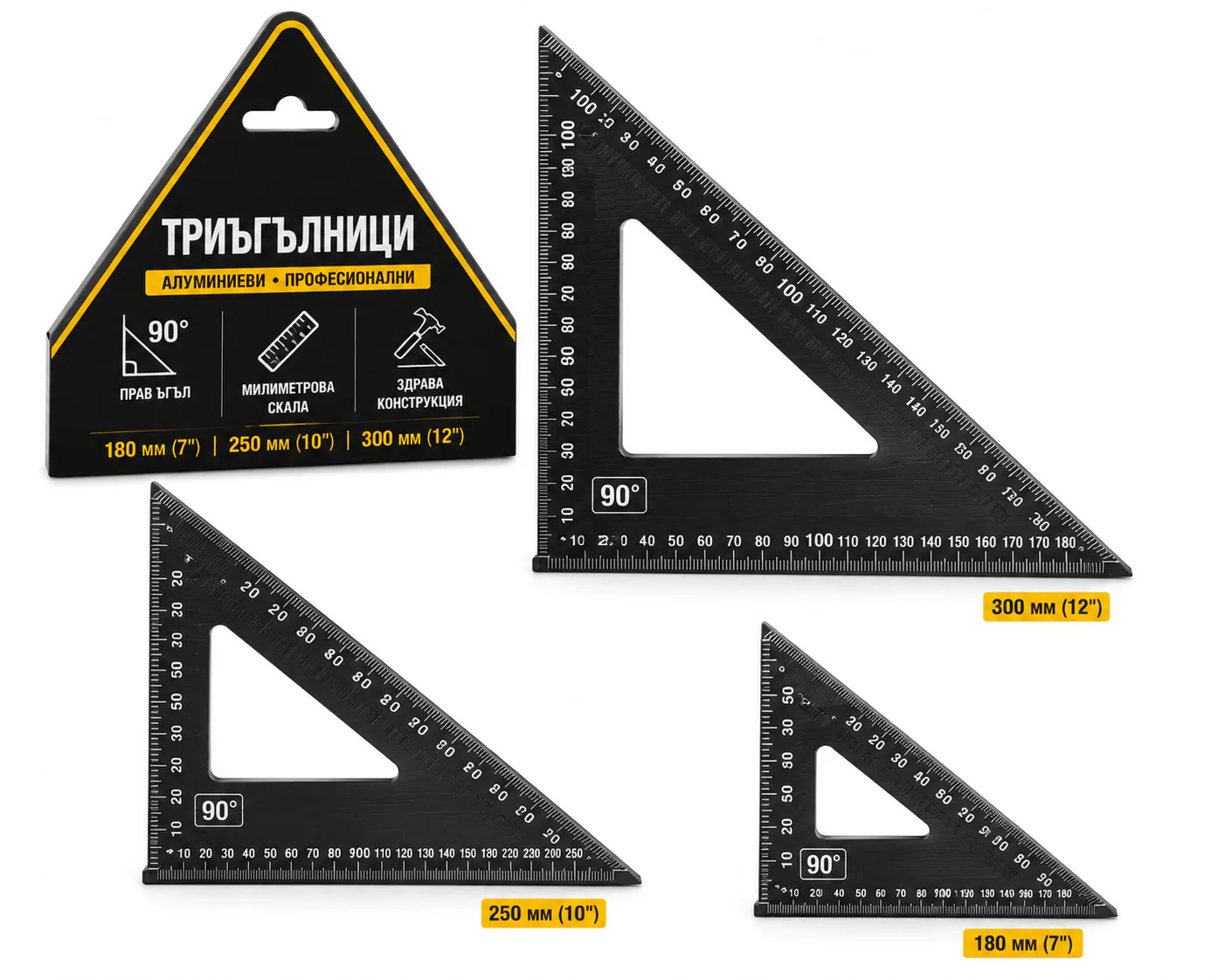
When selecting a set square, consider the size of the tool in relation to the workpieces you are working with. Small set squares are convenient for furniture, boxes, narrow profiles, and installation in confined spaces. Larger models provide a longer marking line and are practical for surfaces, beams, drywall, and building elements.
The material affects the weight, durability, and feel when working. Aluminum models are lightweight and easy to carry; steel ones are preferred for heavier use; and plastic drafting versions are convenient for light measurements and planning. When working on-site, it is helpful for the scale to be engraved, raised, or well-protected against wear.
The scale and markings are important when transferring measurements. Check whether the units of measurement, divisions, and markings are easy to read from different angles and in low light. For carpentry tasks, set squares with clearly marked 45° and 90° angles are practical, and when drawing repeatable lines, pencil slots or channels are useful.
The reference edge determines stability when resting against the workpiece. A wider base makes marking on boards and panels easier, as the tool sits more stably on the edge of the material. Smooth, straight edges are necessary for a precise line without shifting when moving the pencil or marker.
Compatibility with materials and work processes
Triangles are used alongside tape measures, rulers, levels, protractors, marking pencils, knives, saws, circular saws, and screwdrivers. When working with wood and panels, they are convenient for drawing a line before cutting. For metal profiles, they can be used for marking before drilling or cutting. When installing interior elements, they help ensure right angles and align parts before securing them.
When choosing a model of power tool, pay attention to whether the shape allows for stable positioning close to the cutting line. When marking on rough building materials, it is better for the body to be scratch- and impact-resistant, and for fine decorative surfaces, it should have smooth edges that do not damage the material.
Maintenance, Storage, and Accuracy
To maintain its accuracy, the set square must be protected from bending, strong impacts, and prolonged contact with moisture. After use, clean dust, shavings, glue, or construction mixtures from the edges and the scale. For metal models, dry storage reduces the risk of corrosion, and for plastic versions, it is advisable to avoid placing them under heavy tools.
Periodic checks of the right angle are useful during intensive use. An easy check can be performed by drawing a line along one edge, flipping the tool over, and comparing the second line. A discrepancy between the two lines indicates that the tool is no longer accurate enough for precision tasks.
Choosing set squares at Toolsbox.bg
Choose a set square based on the job, the material, and the required precision-a compact model for assembly work, a larger construction version for surfaces, or a carpenter's set square for cutting and joinery. At Toolsbox.bg, you can compare dimensions, materials, scale types, and design features to choose a tool that suits your workflow in the workshop, on the construction site, or at home.