
Straight milling cutter for overmilling
Straight router bit - precise cuts in woodworking
A straight router bit is a cutting accessory for shaping straight grooves, rebates, slots, holes, and straight internal edges in wood and wood-based panels. It works with a router and allows for controlled material removal along a specified line, template, or guide. This type of cutter is in demand in furniture manufacturing, installation work, workshop repairs, and precision tasks at home, where a clean edge and precise dimensions are important.
In the section for straight router bits, you can find models with different diameters, working lengths, shank types, and cutting edge designs. The differences between them affect the width of the groove, the routing depth, performance in hardwood, and ease of use for a series of identical operations. Choosing the right size saves on additional processing and helps achieve a cleaner cut line.
What operations is the straight router bit used for?
A straight router bit is used for making back channels in cabinets, mortises for joints, edge rebates, hinge slots, hardware holes, and template-cut holes. When working with MDF, plywood, particleboard, solid wood, or laminated panels, the choice of cutting edge and the correct feed rate are critical to the final result.
For furniture components, the router must ensure a straight wall on the groove and a bottom with good geometry. For installation tasks, there is often a need to quickly shape recesses for locking mechanisms, decorative trim, or joints. In a service or home workshop, this accessory is useful for adjustments, repairing cabinet doors, making templates, and fitting components.
Main types based on design
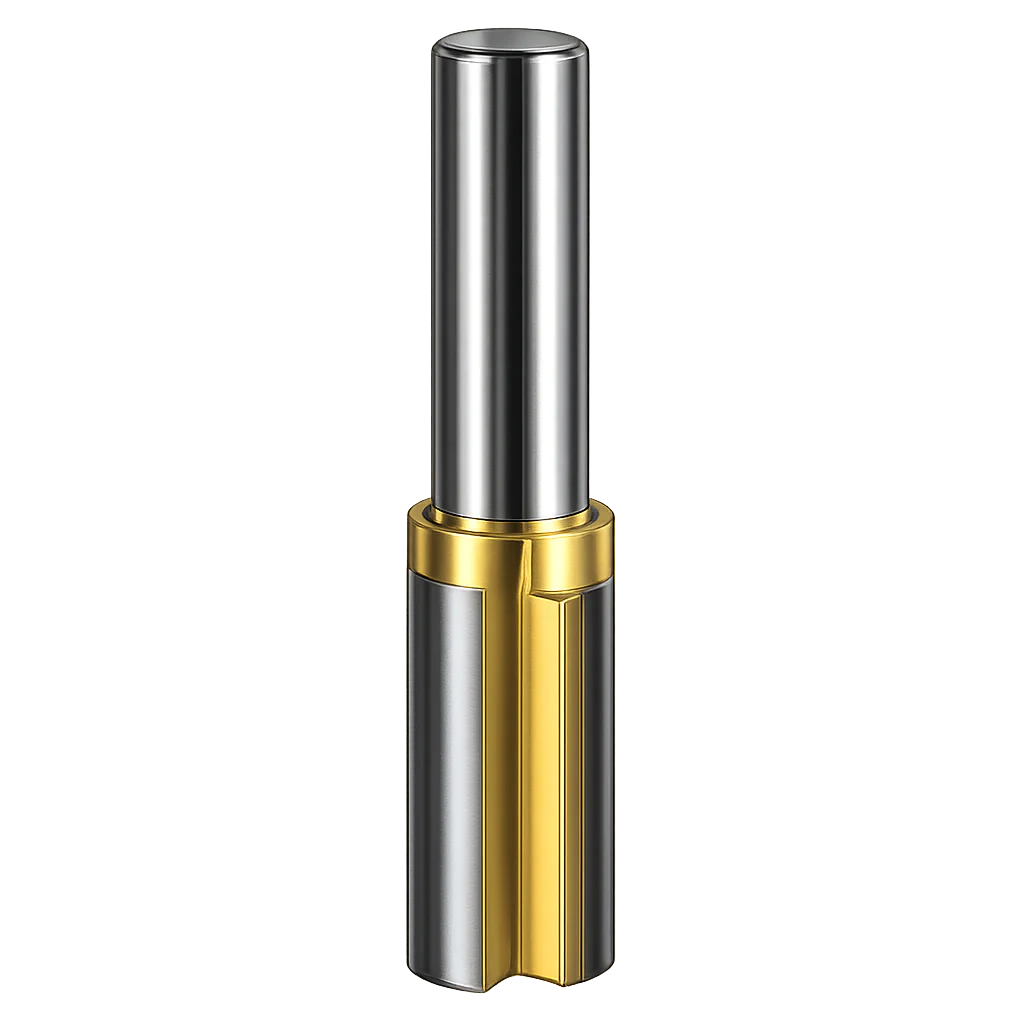
Straight routers differ in the design of their cutting edge. Models with carbide-tipped inserts are preferred for wood panels and more intensive work, as they maintain the cutting edge longer when in contact with adhesives and dense materials. Solid carbide designs are used for finer operations and small diameters where cut stability is required. There are also routers with two or more cutting edges, with their number affecting the removal rate and the smoothness of the machined surface.
For precise channels with exact widths, select a straight router bit with a diameter corresponding to the required size. For deeper slots, consider the working length of the cutting part, not just the total length of the accessory. For narrower channels, smaller diameters require more careful feed and step-by-step milling to reduce the load on the machine and the cutting edge.
How to choose the right size and shank
Before purchasing, you need to compare the router's specifications with the specific router bit. The most important factors are the shank diameter, the machine's compatible collet size, the cutting edge diameter, and the working depth. Many router bits use collets with sizes of 6 mm, 8 mm, or 12 mm, but actual compatibility should be verified using the machine's documentation and the available collet.
| Criterion | What to consider |
|---|---|
| Cutting diameter | Determines the width of the groove, hole, or rebate |
| Working length | Affects the maximum cutting depth |
| Shank diameter | Must match the collet of the router |
| Blade material | Selected based on wood type, surface, and load |
| Number of cutting edges | Affects the smoothness of the cut and the speed of operation |
A straight router bit with a longer shank provides more stable guidance for larger diameters and deeper cuts. Shorter shanks are convenient for compact machines and fine work, but require strict adherence to the maximum cutting depth. For every setting, the shank must be properly secured in the collet, without being clamped too loosely.
Materials, Cutting, and Flute Cleanliness
With solid wood, the cutting edge must run smoothly, without excessive heating and without tearing along the grain. With MDF and particleboard, the load on the blade varies due to the density, adhesives, and abrasiveness of the material. Laminated panels place higher demands on sharpness because the edges can chip if the cut is incorrect or the router bit is dull.
For a cleaner cut, work at the appropriate speed, with a steady hand, and a uniform feed rate. For deeper grooves, it is advisable to divide the cutting process into several passes. This reduces the load on the power tool, extends the life of the accessory, and achieves a more precise geometry. A straight router bit with a sharp and clean cutting edge leaves fewer marks on the walls of the groove and requires less finishing work.
Compatibility with guides, templates, and router tables
The straight router bit can be used with a parallel guide, a copying sleeve, a template, or a router table. When working with a template, accuracy comes from stable support and the correct diameter of the router bit relative to the collet or stop. In the serial production of identical parts, uniform depth adjustment and secure clamping of the material are crucial for repeatability.
When working with a milling table, the straight router bit must be matched to the machine's speed and the size of the workpiece. Larger diameters require a more stable machine and more careful feed. Smaller diameters allow for fine grooves, but should not be overloaded with too deep a cut.
Safety, maintenance, and extended cutting edge life
Working with a router requires a securely clamped workpiece, a clean work area, and personal protective equipment. The router bit must be mounted in a properly functioning collet, and the speed must be adjusted according to the diameter and material. Dull, dirty, or damaged accessories increase vibrations, impair the cut, and strain the motor.
After use, clean the cutting edge of resin, dust, and adhesive residue. Dry storage protects the shank and blades from corrosion, and storing them separately reduces the risk of the cutters bumping into each other. A well-maintained straight router bit cuts more predictably and maintains accuracy during repeated operations.
Choose a straight router bit for your router based on your project
At Toolsbox.bg, you'll find straight router bits for various woodworking tasks-from fine grooves and mounting holes to deeper rebates and slots. Compare the diameter, working length, shank, and material of the cutting edge to select an accessory that fits your machine and the specific operation. This ensures a more precise purchase, and your work in the workshop, on the job site, or at home becomes more controlled and precise.