
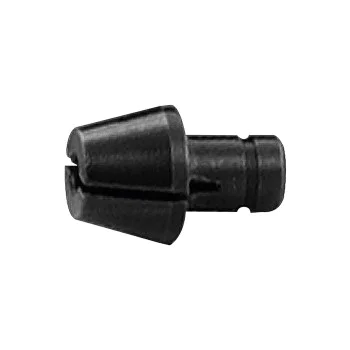
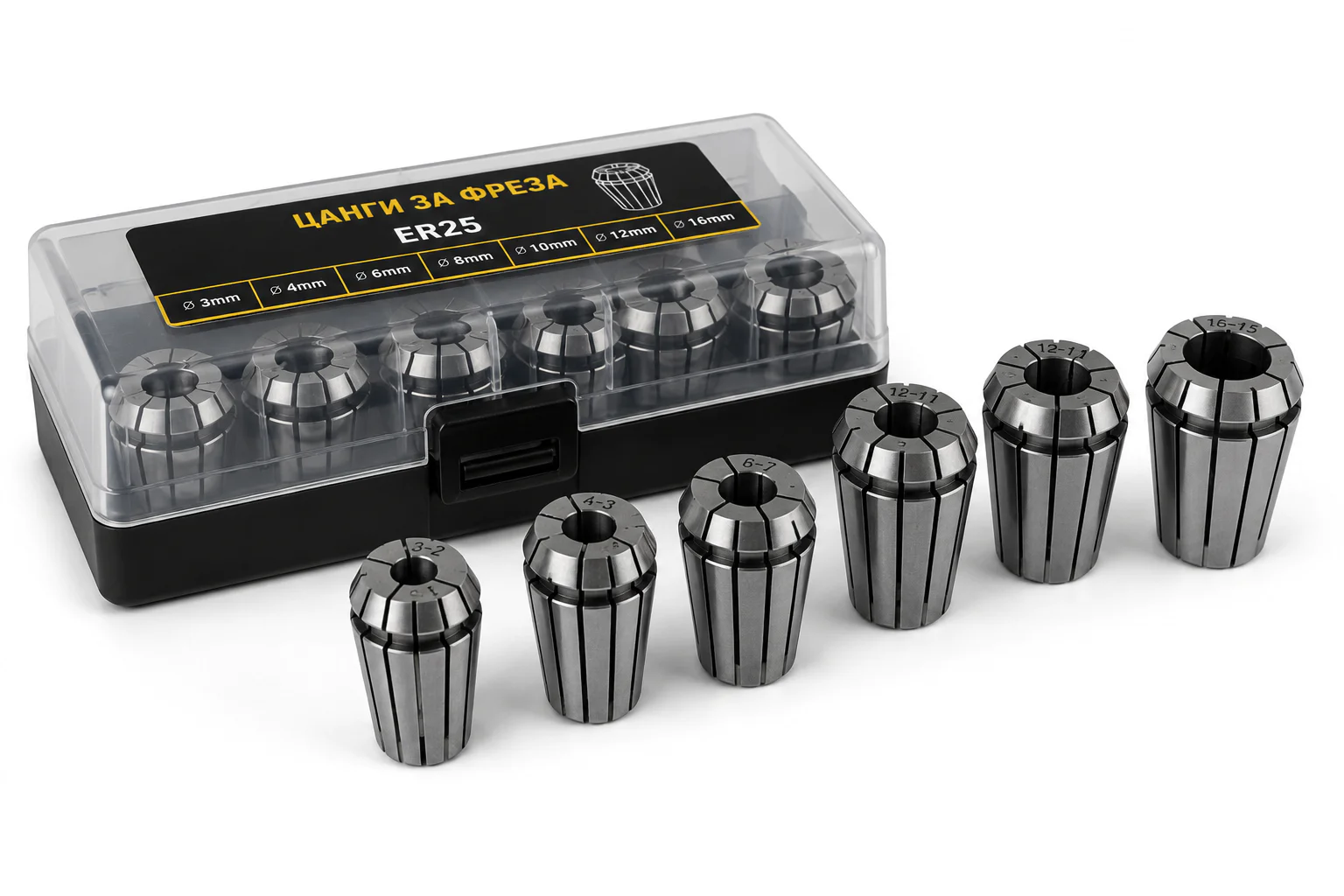
Chucks for milling cutter
Milling cutter collets for precise and secure clamping
Milling cutters are used to precisely secure the cutter to the spindle, chuck, or holder of the machine. They are a small but very important part of the milling set because they directly affect alignment, vibration, cut quality, and safe operation. A properly selected collet holds the tool shank evenly around its circumference, reduces unwanted runout, and helps ensure more controlled machining of wood, plastic, composite materials, or non-ferrous metals, depending on the capabilities of the specific router bit.
In the routercollet section, you will find solutions for various routers, router bits, edge routers, and workshop machines. The items differ in shank diameter, outer shape, collet type, working standard, and compatibility with specific models. The exact size is particularly important when switching between routers with different shanks, because even a slight mismatch affects the clamping and the machine's performance under load.
Applications of router bits in the workshop and on-site
Milling cutters are used for a wide range of operations: shaping grooves, rebates, profiles, holes, edges, decorative edges, and joints. They are essential for professional use in furniture making and installation work, as well as for precision home repairs, detail work, and the maintenance of wooden structures. When working with hand-held power tools, a secure grip is particularly valuable because the operator relies on smooth rotation and predictable behavior of the cutting tool.
In CNC machines and bench-top milling systems, the collet plays an even more critical role in dimensional repeatability. Even a small radial deviation affects the accuracy of the workpiece, the wear on the cutter, and the load on the spindle. Therefore, for production runs, pattern milling, or machining small parts, it is advisable to maintain a set of milling cutters in the most commonly used diameters.
Basic Dimensions and Compatibility
The most common shank diameters are 6 mm, 8 mm, 10 mm, 12 mm, 1/4", and 1/2", but actual compatibility depends on the design of the specific machine and its collet. A collet with the correct inner diameter does not always fit every nut or spindle, so it is necessary to check the outer shape, length, taper, and mounting standard. On some milling machines, the collet works in conjunction with a special clamping nut, while on others it is part of a set with a specific geometry.
Milling collets are also available in various designs depending on clamping accuracy. For rough machining and one-off repairs, a standard collet is often sufficient, provided it matches the size of the milling cutter. For fine milling, edge operations, parts with visible surfaces, or CNC machining, options with better concentricity and less runout are preferred. This preserves the cutting edge and helps achieve a cleaner result.
What to check before purchasing
- Shank diameter-the collet must match the actual size of the router bit, measured in millimeters or inches.
- Machine type-routers, edge routers, bench systems, or CNC spindles may use different standards.
- External profile-the taper, length, and slots of the collet must match the chuck.
- Working accuracy-for fine machining and production parts, a collet with minimal runout is desirable.
- Condition of the nut-a worn or damaged nut impairs clamping even with a new collet.
Materials, construction, and load-bearing behavior
Milling collets are typically made of steel with precision-machined slots that allow for uniform clamping around the tool shank. Good geometry is important because the collet should not clamp at a single point. Even contact prevents the shank from slipping, reduces vibrations, and minimizes the risk of marks on the workpiece. During intensive use in a service center or workshop, it is worth monitoring for wear, contamination, and mechanical damage to the contact surfaces.
Dust, resin, metal shavings, or wood debris between the collet and the spindle can cause misalignment. Before installation, ensure the surfaces are clean and dry, and insert the router bit to the correct depth according to the machine's instructions. It is not good practice to clamp the shank only at the very end, because the load is distributed unevenly. If there are visible cracks, deformations, or difficulty tightening, the collet should be replaced.
Selecting collet chucks for the router based on the type of work
For on-site installation and repair work, sizes compatible with the most commonly used routers for routing channels, rounding, and chamfering are practical. In a furniture workshop, several diameters are often combined to work with routers for hinges, templates, mortises, and profiles. For CNC applications, the selection focuses on precision, repeatability, and a good fit with the spindle, as machining is typically longer and at higher speeds.
If you have cutters with different shanks, a set of collet chucks makes it easier to switch between accessories and reduces the need for compromises with adapters. Adapter sleeves have their place, but direct clamping with the correct collet usually provides better stability. For precise machining of visible edges and parts with tight tolerances, it makes sense to select the collet based on the tool, rather than the other way around.
Maintenance and Safe Operation
Regular care extends the life of the collet and protects the router from improper loading. After use, it is advisable to clean the collet of dust and shavings without applying harsh impacts or grinding the contact surfaces. Storing it in a compartment or box protects the cone from damage. Do not apply excessive force when tightening, as this can deform the element or damage the nut's threads.
Milling cutters are a small accessory, but the stable movement of the cutting tool depends on them. Browse the available options at Toolsbox.bg, compare the size and standard with your machine, and choose a cutter that suits the specific task in the service center, workshop, or for home repairs.